The weirdest thing happened today.
So I live alone, right, and I go to open my fridge this morning to grab the milk for my breakfast bowl of cereal, and my milk is nowhere to be found.
Gone.
I know I had some, because I used it last night while I was making Mac & Cheese.
I asked my mom if she came over and borrowed my milk, and she said she hadn't, but even if she had, it would have had to have happened while I was sleeping.
I am seriously freaking out now. Like either I am going straight up crazy, and just imagined having milk, or someone broke into my house and stole only my milk. I'm not fond of either option.
Thursday, July 10, 2014

Friday, May 27, 2011
How I think the Sahara's resources should be dealt with

(Keep in mind I am a business major, so that's the perspective I took on this)
For a along time the arid regions of northern Africa have been some of the poorest countries in the world, and the reason is climatology. Due to the fact that this region is harsh and dry, it’s residents have been left with hardly any land to cultivate and practically no natural resources, it has been the underdog in the race for wealth, until now. Until recently, places like Mali, Niger, and Chad, just to name a few, haven’t had any natural resources to call their own. But then solar power was invented. This website (that I actually found while ‘Stumbling’), explains that just 90k square kilometers could meet and sustain the entire worlds energy needs. While 90,000 square kilometers sound large, compared to 9,000,000 square kilometers that the Sahara covers, it is only 10% of the entire desert.
One of the main concerns is that westerners will seize control of the land, privatize the efforts, and in no way help these people who mostly live on just a $1 a day. But I have a different idea. For any of you who have seen ABC’s ‘Shark Tank,’ you will understand where I am coming from. The governments of these desolate countries need to seek investors. Not like how America borrows money from China, because of the amount of debt these countries are in, no one will simply lend money to the country as a whole. A business needs to be formed, and then that is what will be invested in in. Say Niger forms the company SolPower; they then pitch their company to the western governments asking for an investment of say, $10 million (they can seek other investors if they need more capital). Say France bites and asks in return for 10% of SolPower, Niger accepts and the deal is on. SolPower begins construction and is soon producing energy and selling it to other counties. America, being the greedy country it is, agrees to buy an entire years production of energy from SolPower for $100 million. Now, because SolPower has made a profit, it owes 10% of it to France, which just happens to be $10 million, the amount of its initial investment, and in just one year its investment has paid for itself and France begins to make a profit. Of course things get more complicated when an invested country decides to purchase energy, but for the sake of the example, I kept things easy.
The only foreseeable problem is that these poor countries lack very organized governments. But hey, pipe dreams?
Friday, May 20, 2011
Does every little bit help, or are we wasting our time?

One of the discussions in class this week was talking about how just unplugging a phone charger, or another phantom energy sucker, won’t do much to help combat our energy crisis. On page 3 of Without Hot Air, David MacKay talks about people telling you that unplugging electronics that are in standby mode and every little bit helps is “crazy innumerate codswallop.” He says, “if everyone does a little, we’ll achieve only a little.” I disagree. I think that people like the BBC and its American counterpart, whatever that may be, encourage us to do things as simple as unplugging our phone charger because it makes us think, it gets the ball rolling, it makes us start to think about our decisions. If we get in the habit of unplugging phone chargers, or unplugging you printer, turning off lights, reducing the thermostat by 1º, it could lead people to install low flow shower heads, upgrading to energy efficient appliances, collecting rainwater, and then even to install solar panels or drive a hybrid. I mean I understand what MacKay is saying, just unplugging your phone charger will barely make a difference, so why do it? Because it’s not the act, it’s the practice.
This subject came to mind when I was grocery shopping today. My boyfriend likes to stick to brands he knows, he is your typical ‘man’ when it comes to shopping, and hates accompanying me shopping. But one thing I noticed is that when he tries to put a name brand product in the cart, and I grab it, put it back, and replace it in the cart with a generic item, he always says: “it’s only a couple cents cheaper, what’s the big deal?” I have finally realized that he’s right (he can never know I said that), just a couple cents is not a big deal, but if I do that, choose the cheaper generic instead of the name brand on every item I buy, it adds up; I can usually save 15-20%. MacKay has the same thinking, if all you do is ‘just unplug your phone charger’ (this example is getting old, sorry), then you will only save a couple cents, but if you take that perspective with everything you do, then it will add up! But then again, that’s just my two cents. (hahaha)
MacKay MyHero
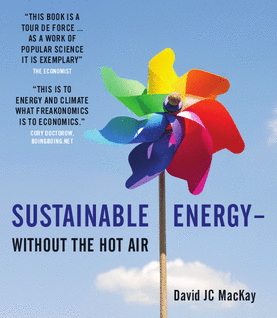
So recently in class we have begun reading David JC MacKay's Without Hot Air, a book, if you will, provided to educate the consumer instead of imposing the author's beliefs on the reader. Coming from the book we read at the beginning of the term, Blessed Unrest by Paul Hawken, this book is much less emotional. MacKay uses facts and provides the reader the information need to facilitate the reader to make their own decision; Hawken writes about what he is passionate about and what he believes in. For a person like me who would rather do long division than be forced to be creative, MacKay is much more my style. But it is my belief that both authors need to exist, because not everyone learns or critically thinks in the same fashion. Some people really found Blessed Unrest interesting and informative, where as I hated it, and it was the least favorite part of my week. But both of these books need to exist for people to become educated on what is/has happen(ing/ed) in this world and what they can do to help and prevent things like this in the future. While I like math because everything has a correct answer, some people like to express their feelings, and leave things to interpretation; this is how these two authors differ. I just want to clarify something before I wrap this up: I would still recommend Blessed Unrest to someone, it just depends on who it is and their style.
Friday, May 6, 2011
Simpler times: my latest pipe dream

Last term, for a final project in my SINQ Pop Culture class, we were asked to analyze an animated film; my group chose Pixar’s Wall-E. A main point we discussed in our presentation was corporate America and the role ‘mega-corporations’ would hold on the future. I was constantly reminded of the work I did on this project while reading “The Rights of Business” chapter in Paul Hawken’s Blessed Unrest for this weeks readings. This week in class, we were graced by Professor Brower (the daughter of Jack Brower) who talked to us about her father after we watched the documentary “Monumental” based on his conquests. She mentioned the term “simpler times” throughout her visit to class and it really resonated with me, as well as making think of my previous class project and Hawken’s writings.
 On page 60 of his book, Hawken talks about an English group know as ‘Luddites.’ These people tried to fight back as their industry became corporatized and did so in a very physical way. I had no idea that such a seemingly current movement took place over a hundred years ago. Today, more than ever, un-employment rates are at their highest. Progress for progress’ sake should be frowned upon; companies should hire human workers rather than buy machines or robots; mega-corporations should build factories in our homeland rather than outsourcing for cheap labor. Instead of the Industrialization era that caused all these machines to replace the jobs of people like the Luddites, we are in a Technological era and our human workers are being replaced by machine counterparts.
Back to what Professor Brower talked about of simpler times, we are living in such a complex age, and as much as I am grateful that I live in a time where we have healthcare and many other modern commodities, I jealous of those who lived in a simpler time, a much simpler time: no paper money, no bills, no taxes, no materialistic goods, just people doing what they needed to sustain life.
Friday, April 15, 2011
Aren't We All Descended From Apes Anyways?

Whether it was A Short Account of the Destruction of the Indies by Bartolome de Las Casas or Exterminate the Brutes: One man's Odyssey into the Heart of Darkness and the Origins of the European Genocide by Sven Lindquist, I felt like I was constantly surrounded by literature that compared human actions to those of animals.
I grew up in a small town in Eastern Oregon before moving to Portland to go to school; how different the two places are. In my hometown, my backyard was wonderful National Forests full of wildlife and beautiful scenery. I was spoiled to say the least. But growing up around so much wildlife I quickly learned how they acted, what their instincts were, I was able to predict their movements. This was something that was vital for our way of life because most people lived off of what the harvested and would be in a for long winter if they weren't able to kill something large enough to feed their family from. This animal instinct and natural way of life is something I see mirrored in the way the Spanish conquistadors acted as well as many others. The way a predator acts if threatened is usually to kill. Or if an animal finds something on it's territory, it will fight the challenging animal.
Much how the way of life was in these historic times, barbaric, the human actions were as well. To play off of what I discussed in last week's entry, we hadn't yet made the mistakes to learn from yet. We didn't see how destructive the way of life was, or how gluttonous some society's lived; something we are coming to realize yet again.
Tuesday, April 5, 2011
What I took from Martha Nussbaum’s ‘Citizens of the World’ (a chapter from her book, Cultivating Humanity)

Throughout Nussbaum’s piece, she is constantly touching on worldly cultures and ideals, something that really made me think about my personal experiences. 4 years ago, I went on a private exchange to Germany, and also visited The Netherlands, Belgium, and Denmark. At the young age of 16, I was blown away by the different cultures and ways of life; a wonderful experience I was being constantly reminded of when reading Citizens of the World. Nussbaum doesn’t necessarily talk about sustainability, but since it is the subject of this course, it was a topic that I constantly paused and related her words to.
America is a comparatively young nation, and in my opinion we are making the same mistakes that our Eurasian peers made long ago. We are treating our land and natural resources like they are expendable and being overzealous in our consumption, something we are currently coming to realize. How this relates back to my experience abroad was that I could tell that these cultures had a lot more history than my homeland did, and it showed in their subconscious actions, beliefs, and how that acted as a society. The particular family I stayed with had one vehicle for their entire family, they composted all that they could, grew all the fruits or vegetables they were able to and bought locally the ones they couldn’t. If they didn’t need to drive somewhere, they took a train or bus, or even better, rode their bikes. They had a grass roof, rain barrels to water their garden, LED lights in every room that even had lights, and low flow plumbing fixtures. They didn’t choose to live this way, like many American households are starting to do, they lived this way because this is how their culture lives; this is what their society deems normal.
I hope that someday, in the near future, America will live like this, and learn from a mistake already made for us.
Subscribe to:
Posts (Atom)